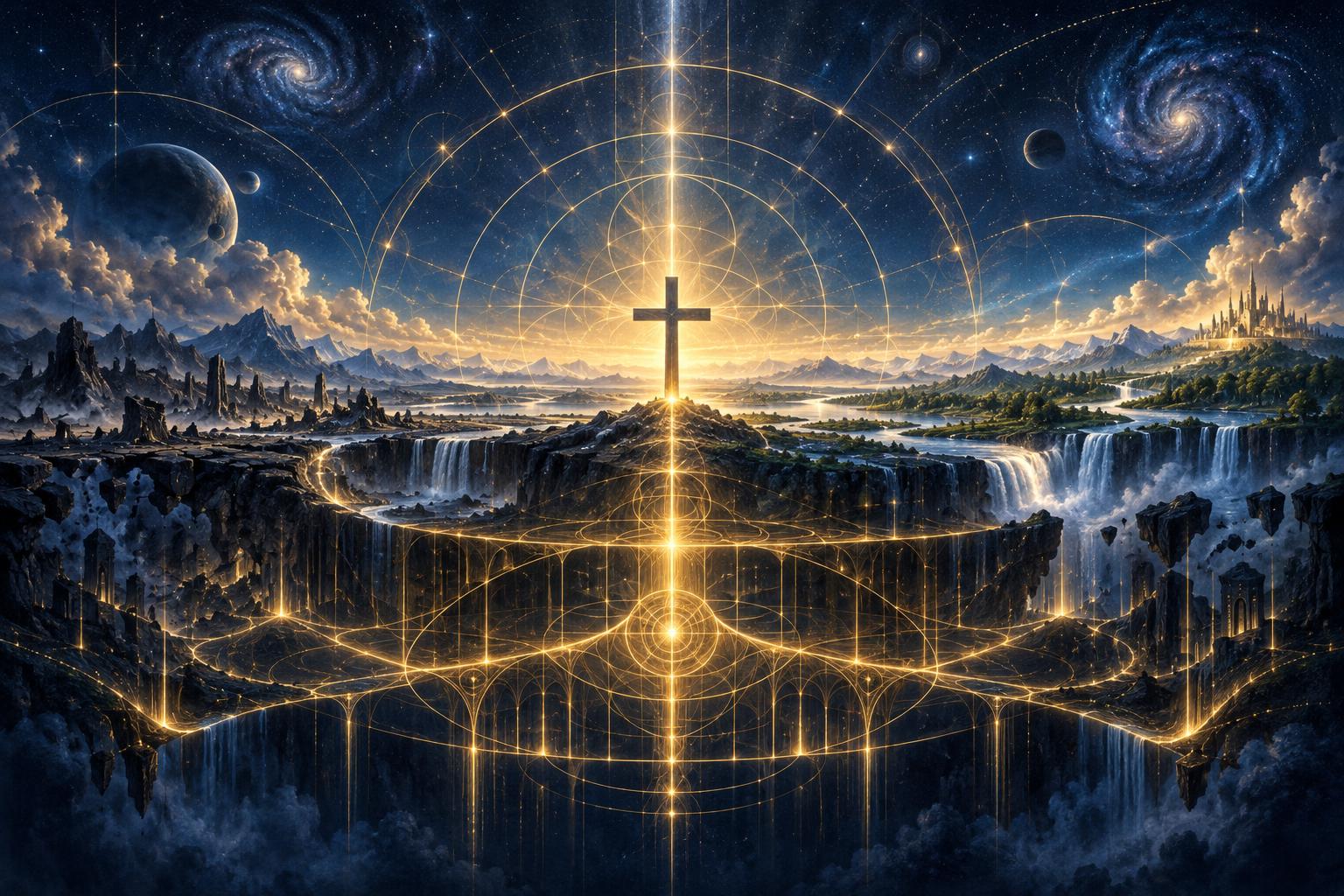

Sustaining Grace
Grace for the Long Road: Some trials end quickly. Others ask us to keep walking. This episode explores the grace that sustains believers through weariness, delay, grief, and the ordinary demands of faithfulness.
The Eternal Blueprint: How Grace Was Planned Before Time Began
A Narrative Study & Companion Guide on the Sovereign, Pre-Temporal Architecture of Divine Redemption
1. The Myth of the Divine Emergency Plan
One of the most persistent misconceptions in popular theology is the idea that divine grace was an emergency reaction to human rebellion. Under this flawed narrative, God created a pristine universe with Plan A, but when Adam sinned in the Garden of Eden, the original design collapsed. Faced with unexpected catastrophe, God was forced to improvise Plan B—a rescue operation called grace to salvage a ruined creation.
Scripture thoroughly dismantles this reactionary view. Divine grace is not a celestial fire extinguisher brought out when history caught fire. It is not an afterthought, a backup strategy, or a divine contingency plan. Grace is the eternal blueprint of God—conceived in the unapproachable light of eternity past, established before the foundation of the world, and unfolding with absolute precision across time and space.
Core Insight: Grace was not born in response to human failure in Genesis chapter three. Grace was established in the eternal decree of God before time began. Redemption is not Plan B; it is the central, eternal Plan A of cosmic history.
2. Pre-Temporal Grace: Saved Before Time Began
In Second Timothy chapter one, verse nine, the Apostle Paul writes that God 'has saved us and called us with a holy calling, not according to our works, but according to His own purpose and grace which was given to us in Christ Jesus before time began.' The Greek phrase used here—pro chronōn aiōniōn—literally means 'before eternal ages' or 'before pre-temporal ages.'
Consider the staggering implications of this truth. Before the sun was ignited, before gravity bent space, and before the first human breath was drawn, your salvation was already settled in Christ. Divine grace was assigned to you before you ever existed to perform a single work, earn a single merit, or commit a single sin.
This pre-temporal reality is echoed in First Peter chapter one, verses eighteen through twenty, where Peter declares that Christ was 'foreordained before the foundation of the world, but was manifest in these last times for you.' The cross of Calvary was not an emergency rescue invented on Golgotha; it was the execution of an eternal council held within the Godhead before creation.
3. The Covenant of Redemption: The Trinitarian Pact of Grace
Classical theology describes the eternal blueprint of grace as the Covenant of Redemption (Pactum Salutis). Before time began, the Father, the Son, and the Holy Spirit entered into an intra-Trinitarian agreement of eternal love and redemption:
- God the Father decreed the plan of salvation, choosing a people in Christ and giving them as a love-gift to His Son (Ephesians 1:4–5; John 6:37).
- God the Son willingly agreed to become incarnate, take on human flesh, represent His people as the Second Adam, and pay their law-debt on the cross (Hebrews 10:5–7; John 10:17–18).
- God the Holy Spirit committed to apply the finished work of Christ to the hearts of believers, regenerating them, sealing them, and preserving them unto glory (Ephesians 1:13–14; Titus 3:5–6).
4. The Cosmic Climax: Uniting All Things in Christ
The eternal plan of grace does not merely rescue individual souls; it encompasses the cosmic restoration of all creation. In Ephesians chapter one, verses nine and ten, Paul unveils the mystery of God's will: 'according to His good pleasure which He purposed in Himself, that in the dispensation of the fullness of the times He might gather together in one all things in Christ, both which are in heaven and which are on earth—in Him.'
The Greek verb translated as 'gather together in one' is anakephalaiōsasthai, meaning to sum up, harmonize, or bring under a single head. Human history is not a series of random, chaotic accidents. History is a divine symphony moving toward an inevitable, glorious resolution where every fractured piece of creation is brought into perfect harmony under the supreme lordship of Jesus Christ.
Comparative Analysis: Reactionary Emergency vs. Eternal Blueprint
Dimension
Human Merit / Emergency View
Biblical Eternal Blueprint
Origin & Timing
Invented in Genesis 3 as a sudden reaction after human sin occurred.
Established before time began (pro chronōn aiōniōn) in eternal decree (2 Tim 1:9).
Foundational Motive
Divine obligation to repair a damaged project and salvage what remained.
Sovereign love and eternal purpose within the Trinitarian Council (Eph 1:4–5).
Soteriological Basis
Conditional favor dependent on human performance and Cooperation.
Unconditional, sovereign grace secured entirely by Christ's finished work (Eph 2:8–9).
Ultimate Goal
Rescuing individual humans from hell to minimize creation losses.
Cosmic recapitulation (anakephalaiōsis)—uniting all things under Christ (Eph 1:10).
**Living in the Security of the Eternal Blueprint:
**When you understand that your salvation was planned before time began, fear loses its grip. Your security does not rest on the fragility of your daily performance; it rests on the eternal, unchangeable decree of Almighty God. The God who planned your redemption before the stars were born will faithfully preserve you until the final cosmic climax when Christ is all in all.
Reflect & discuss
- How does knowing that God planned grace before time began bring comfort to your heart?
- Where might you rest in Christ’s finished work rather than your own performance today?
- How does God’s promise to unite all things in Christ give you hope amid life’s uncertainties?
Up next · Theology of Grace
 Sufficient GraceIs God’s Grace Enough?Paul pleaded for his weakness to be removed. God answered with a promise: “My grace is sufficient for you.” What does that mean when the struggle remains?
Ask about this teaching
Have a question?
Questions & reflections
Be the first to ask a question or share a reflection.