
About the host
From Demigod to Disciple
Mahesh Bandarupalli
Listen to my testimony
Read my testimony
From Demigod to Disciple
The Conversion, Calling, and Grace Journey of Mahesh Bandarupalli
1. The Exalted Demigod and Priesthood
Born into an orthodox Brahmin family, Uma Mahesh Bandarupalli was immersed in religious fervor from early childhood. Guided by his grandfather, he mastered Sanskrit, the Upanishads, the Vedas, and ancient philosophical commentaries. By the age of seventeen, he was formally ordained as a priest and Vedic teacher. His expertise quickly expanded into complex occult sciences, including palmistry, astrology, and Hatha Yoga.
In his community, Mahesh’s ritual authority grew immense. He was chosen to perform exclusive rites, marriages, and high-level ceremonies. Villagers from surrounding regions travelled miles to seek his counsel, washing his feet and sprinkling the ablution water upon their heads. Hailed as a 'Chinna Baba' (Small Guru) and treated as a living demigod, his rising status fueled an overwhelming sense of religious pride.
Accompanying this pride was an intense hostility toward Christianity. Viewing it as an imperialist tool that corrupted national heritage and catered only to lower castes, Mahesh delighted in verbally humiliating Christian peers in debate. Upon entering medical school, he maintained his religious leadership while actively conspiring with fundamentalist groups to identify, corner, and persecute evangelists.
2. The Question That Rattled a Kingdom
During his early days at medical school, Mahesh engaged in frequent, vociferous arguments with Christian classmates, taking pleasure in overwhelming them with his oratorical strength. Yet he noticed with lingering surprise that despite his verbal abuse, his classmates responded with quiet grace rather than retaliation.
Then came the turning point. One day, a Christian classmate looked at him and asked a simple, penetrating question: 'Do you have a personal relationship with God?'
The question struck Mahesh like a physical blow, leaving him completely speechless. Though he possessed vast intellectual knowledge and knew precisely which ritual or chant to perform to secure specific material favours—such as a job or a spouse—he realised his connection to the divine was entirely mechanical and transactional. He had head knowledge and ritual mastery, but no personal relationship with a living God.
3. The Secret Pursuit in the Library
Embarrassed by his inability to answer and driven by a desire for revenge, Mahesh resolved to dismantle the authority of the Christian faith by proving the Bible was a collection of lies. However, to protect his public reputation as a fierce Christian-hater, he could not risk reading a Bible at home.
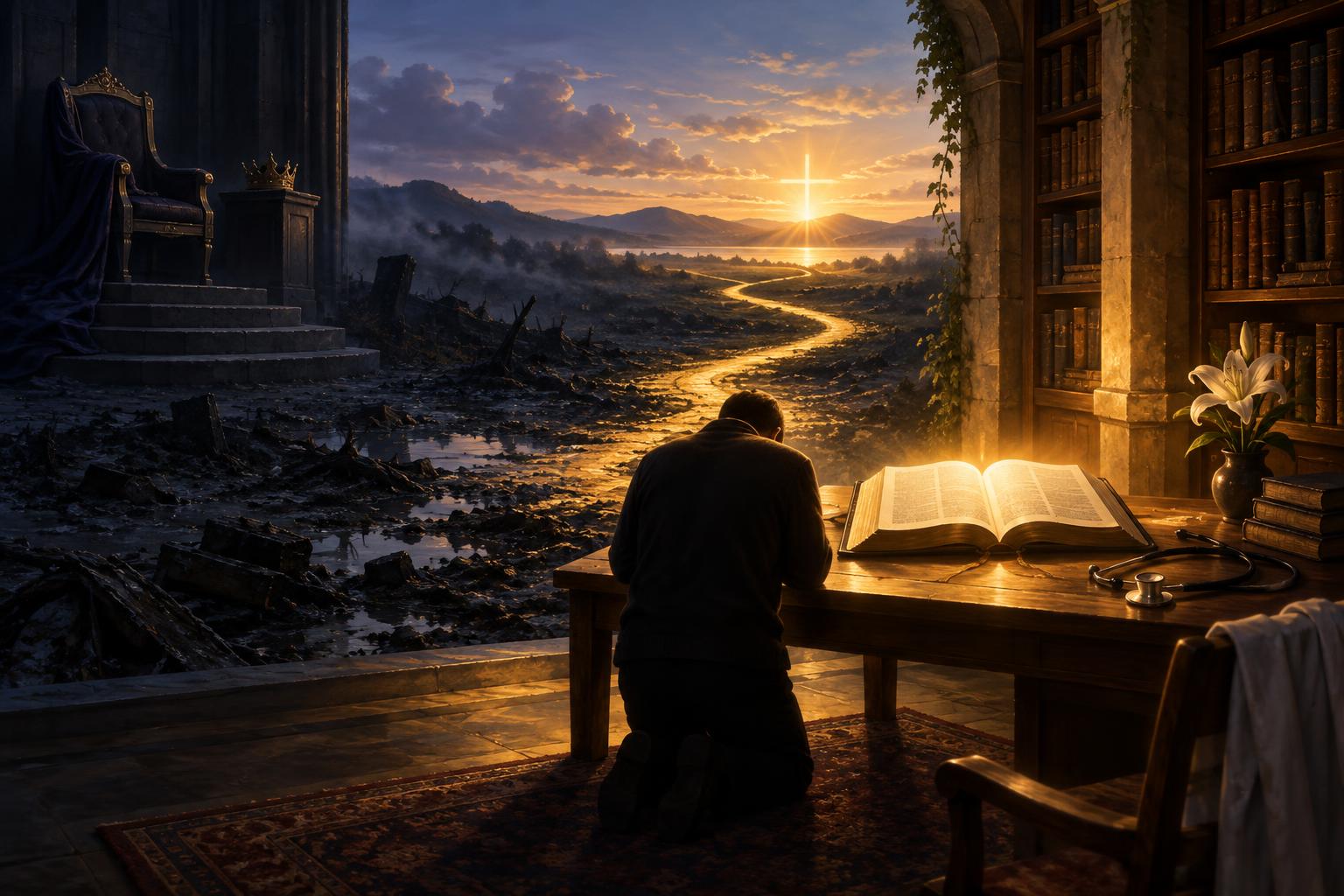
Every evening after medical classes ended, Mahesh secretly walked three miles to a regional library. Tucking himself into an obscure corner, he opened the New Testament. Skipping past historical records, he reached Matthew 5—The Sermon on the Mount.
Expecting familiar moral maxims, Mahesh was unexpectedly pierced by the living nature of the text. As he read Jesus’ words—blessing the poor in spirit, the meek, the merciful, and the pure in heart—he felt as though Christ Himself was measuring his soul. To his horror, Mahesh realised he possessed none of the qualities required for the Kingdom of Heaven. Where he had seen himself as holy and exalted, the Scriptures exposed his deep spiritual bankruptcy.
4. Comparative Scriptural Inquiry
In deep anguish, Mahesh threw the Bible away, attempting to erase its haunting claims from his mind. But the conviction would not leave him. Recalling an old proverb—'a diamond can be cut only by another diamond'—he decided to embark on a rigorous comparative study between his own scriptures and the Bible.
Visiting an ancient manuscript library, he spent long nights examining scriptures across world traditions. His investigation revealed stark internal philosophical contradictions within his own background regarding human sin. More importantly, Mahesh realised that while all other religious systems relied on human self-effort or endless waiting for rescue, the Bible presented a radical truth: God Himself had come down in human history to rescue sinful man.
5. The Shivaratri Miracle and Brokenness
The climax occurred during a major religious festival. Mahesh was expected to lead special rituals at the local temple, a moment his family viewed as a test of his religious loyalty. Having discovered the truth, Mahesh knew that participating in idol worship would be a conscious betrayal of God. In desperation, he uttered his first genuine prayer: 'God, if You can see my plight, please get me out of this somehow. I do not want to go to the temple.'
Immediately, a raging fever swept over his body. Deeming him too ill to attend, his family left for the temple, leaving him alone at home. As he lay alone on his bed, an overwhelming wave of spiritual anguish broke over him. God brought his past sins before his eyes like a movie—his pride, his hatred, his idolatry, and his cruel persecution of believers. Weeping profusely, his self-righteousness completely broke. Mahesh confessed his guilt, acknowledged his lost condition, and asked the Lord Jesus Christ to forgive his sins and save him.
6. Amazing Grace: From the Miry Depths to Heavenly Places
Above all, this testimony is a monument to the unmerited grace of God—the most powerful force under heaven. Looking back, Mahesh realises it was not his intellectual curiosity, nor his comparative study, that saved him; it was sovereign divine grace that reached down into the miry depths of his pride, idolatry, and sin.
That irresistible grace pulled him out of the mire and placed him straight into the holiest place in heaven as a beloved child of God, seated with Christ in heavenly places. When he was an enemy of God, Christ sought him; when he was dead in his transgressions, grace made him alive. Amazing grace indeed—a divine power that does not merely reform a self-righteous priest, but transforms him into a redeemed, adopted son of the Living God.
7. The Furnace of Persecution and The Damascus Intersection
Mahesh’s conversion was met with immediate, severe backlash. Treated as an outcast and an untouchable, he was disowned, beaten, spat upon, and survived threats from former associates who viewed him as a traitor. Yet, sustained by the grace of Christ, he persevered through medical school, emerging not only as a committed believer but as a skilled physician.
Over the decades, Mahesh’s medical path led him from the high-stakes intensity of the Intensive Care Unit (ICU) to the relational heart of General Practice. In the ICU, he mastered the cold mechanics of biological survival, treating bodies in extremis. But in General Practice, he confronted a quieter, more pervasive siege: a chronic despair of the soul that no prescription pad could cure.
Today, Mahesh operates at 'The Damascus Intersection'—the convergence of clinical science and biblical hope. Challenging the church to abandon the false divide between the biological and the spiritual, he teaches that depression is often a state of whole-body biological fatigue rather than a mere lack of faith. By framing biomedical care as God’s ordained provision to restore the physical vessel, he points sufferers to the ultimate anchor: the unilateral, unwavering New Covenant secured by Jesus Christ.